 Kagenten
Claude Haiku 5.5 launched on October 7, 2026 as Anthropic's cheapest and fastest model, and this page collects its benchmark scores, pricing, and speed from primary sources — Anthropic's official announcement and documentation, plus independent measurements from Artificial Analysis — and explains what they actually mean for your project. All figures below are from a data snapshot taken on October 8, 2026.
Claude Haiku 5.5 (claude-haiku-5-5) is the small-model tier of Anthropic's Claude 5.5 family, built for high-volume, latency-sensitive work: classification, routing, extraction, summarization, and subagent tasks. It is the first Haiku with an adjustable effort setting, so teams can trade intelligence against cost per task instead of switching models.
Key specifications (source: Anthropic model page):
| Spec | Claude Haiku 5.5 |
|---|---|
| Released | October 7, 2026 |
| Context window | 1,000,000 tokens |
| Max output | 128,000 tokens (300K on Batch API beta) |
| Input → output | Text and images → text |
| Thinking | Adaptive, effort-controlled (low → max) |
| Knowledge cutoff | June 2026 |
| Retirement | Not sooner than October 7, 2027 |
Short answer: it is a large step up from Haiku 4.5 on every benchmark Anthropic publishes, and it clearly beats OpenAI's GPT-6 Luna on computer use and visual reasoning — but two headline numbers need careful reading, which we do below.
Anthropic's official announcement reports:
| Benchmark | Haiku 5.5 | Haiku 4.5 | GPT-6 Luna | Sonnet 5.5 (ref.) |
|---|---|---|---|---|
| OSWorld 2.1, computer use (offline subset) | 72.4% | 15.7% | 48.9% | 83.9% |
| Terminal-Bench 4.0, agentic coding | 39.2% | 0.0% | 16.4% | 70.6% |
| Chartography, visual reasoning (no tools) | 46.4% | 6.4% | 29.1% | 61.6% |
| Humanity's Last Exam, reasoning (no tools) | 45.9% | 10.2% | — | 56.9% |
| GDPval-AA v2.1, knowledge work (Elo) | 1620 | 735 | 1437 | 1840 |
| FrontierCode 1.1 (Main), coding | 46.4% | — | 42.4% | 52.1% |
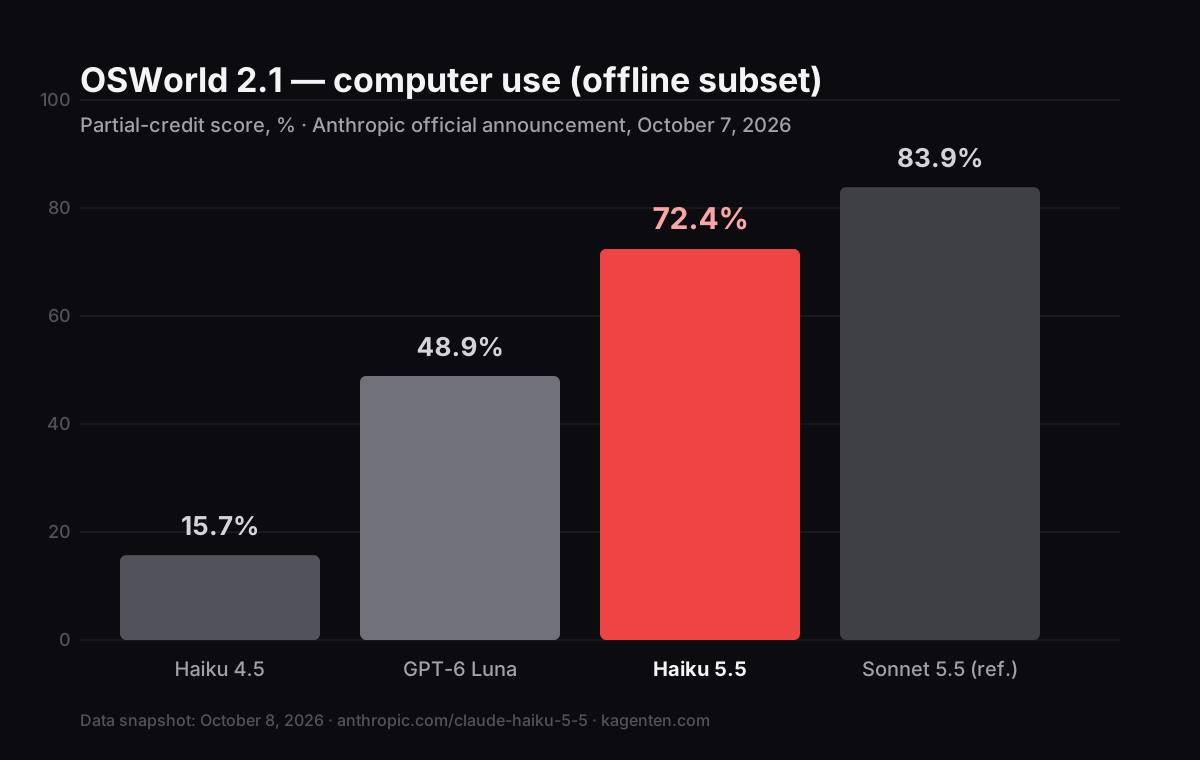
Two honest readings of the headline numbers:
Independent measurements agree on the tier: Artificial Analysis rates Claude Haiku 5.5 (Low effort) at 29 on its Intelligence Index (v4.3.2) — #22 of 182 models, well above the tier median of 13 (AA model page).
Per-token, Haiku 5.5 costs one-tenth of Haiku 4.5 at standard prompt lengths — but the pricing is tiered, and your real bill depends on token counting. Here is the full picture (source: official pricing):
| Price (per million tokens) | Haiku 5.5, prompts ≤100K | Haiku 5.5, prompts >100K | Haiku 4.5 (all prompts) |
|---|---|---|---|
| Input | $0.10 | $0.50 | $1.00 |
| Output | $0.50 | $2.50 | $5.00 |
| Cache read | $0.01 | $0.05 | $0.10 |
Prompt caching saves up to 90% and batch processing a further 50%. Two cost caveats worth knowing before you budget:
It is Anthropic's fastest model to date, and early customers measured it that way — Asana reported "over a 30% reduction in latency for task completions and up to 2.5× faster inference per agent turn" in early testing (quoted in the announcement).
Independent measurements from Artificial Analysis (October 8, 2026 snapshot): 181.2 output tokens per second (#24 of 182, versus a 111.2 median) and a time-to-first-token of ~12 seconds. That TTFT looks high until you know why: adaptive thinking is on by default, so the model thinks before it streams. For latency-sensitive products, the effort parameter — not prompt tricks — is the knob that trades that first-token delay against quality.
For new workloads, yes — Haiku 4.5 is now a legacy model whose retirement "is not sooner than October 15, 2026," and 5.5 beats it on every published benchmark at a tenth of the sticker price. Migration is not a drop-in replacement, though. The official migration guide lists breaking changes that return 400 errors: manual extended thinking (budget_tokens) is gone in favor of adaptive thinking, non-default temperature/top_p/top_k are rejected, and assistant-message prefill is no longer supported. Recount your tokens (~30% more for the same text) before updating cost estimates.
No. Anthropic's official specification lists its I/O as "Text and images → text": it reads images but outputs text only. Haiku 5.5 is notably better at reading images than its predecessor — visual reasoning jumps from 6.4% to 46.4% on Anthropic's Chartography benchmark, and computer use (which is largely screenshot understanding) jumps from 15.7% to 72.4% — but understanding an image and creating one are different capabilities, handled by different model families.

If you came here looking for image generation, that is a different tool category entirely — diffusion-based and autoregressive image models, not text LLMs. That is what Kagenten's AI image agent does: you describe what you want in plain language, and it produces a finished image.
 The image above was generated with Kagenten's AI image agent — the kind of output a text model like Haiku 5.5 cannot produce.
Use it for what Anthropic built it for: high-volume classification, routing, extraction, summarization and compaction; subagent work alongside Opus 5.5 or Sonnet 5.5; browser and desktop automation; and focused, small-scope coding edits. Its speed makes it practical for real-time chat, voice agents, and live support.
Do not reach for it when a task needs frontier-level reasoning or long-horizon agentic coding — Sonnet 5.5 leads it on every benchmark row above, and the price gap to $2/$10 is small compared to the cost of failed attempts.
We build and run an AI image agent at Kagenten, and choosing the model that routes every incoming request is exactly this class of decision: you need fast, cheap, reliably good-enough reasoning at volume, with a clear picture of what each benchmark number does and doesn't promise. These are the same trade-offs we weigh — and you can see the result live with 10 free credits.
No. Its official input/output is "Text and images → text" — it can read and reason about images, but it only outputs text. Image generation requires a dedicated image model; Kagenten's AI image agent is one example.
Yes. Per-token it is one-tenth the price ($0.10/$0.50 vs $1.00/$5.00 per million tokens for prompts up to 100K), and Anthropic states the average cost of running it is around 75% lower once the new tokenizer's ~30% token inflation is accounted for.
1,000,000 input tokens, up from 200,000 in Haiku 4.5, with a maximum output of 128,000 tokens (300K on the Batch API beta). Prompts longer than 100K tokens are billed at a higher tier.
Yes, for focused coding, subagent tasks, and tool-driven automation: it scores 39.2% on Terminal-Bench 4.0 (from Haiku 4.5's 0.0%) and 46.4% on FrontierCode 1.1, and Anthropic recommends pairing it with Sonnet 5.5 or Opus 5.5 as a subagent. It is not a frontier coding model — Sonnet 5.5 scores 70.6% on Terminal-Bench 4.0.
All data in this article comes from a snapshot taken October 8, 2026, and links to primary sources so you can verify every number:
How this article was made: benchmark figures were collected from the primary sources above on October 8, 2026; AI tools assisted with drafting and formatting, and every number was verified against the sources listed. Benchmark scores change as vendors update evaluations — check the linked pages for the latest values.
Last updated: October 8, 2026.